Finasteride or Minoxidil for Hair Loss: A Complete Guide
Finasteride or minoxidil is one of the most common search questions in dermatology since both medications can slow hair loss. The right answer depends on several factors, including sex, hair loss pattern, tolerance, goals, and whether the hair loss is truly androgenetic alopecia [1].
Quick Answer
- For men with classic male pattern baldness, finasteride usually targets the underlying hormone pathway more directly. On the other hand, minoxidil promotes hair growth through a different route and has broader use in men and women [1].
- Finasteride and minoxidil together give the best results because combination therapy can affect DHT-driven follicle miniaturization and the growth cycle at the same time [4][6].
Male Pattern Baldness, Androgenetic Alopecia, and Hair Loss
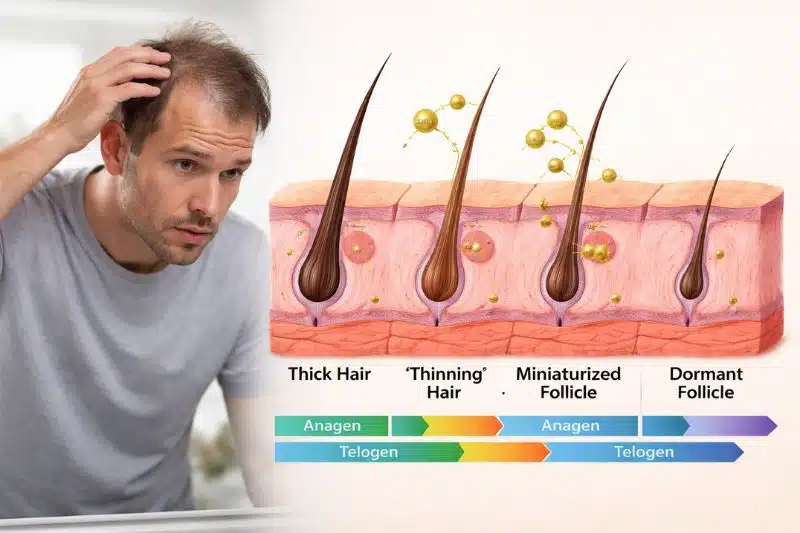
Male pattern baldness and female pattern hair loss are both forms of androgenetic alopecia. The latter is a non-scarring alopecia that affects hair follicles. In at-risk people, testosterone converts to dihydrotestosterone (i.e., DHT), which is the hormone that’s responsible for progressive follicle miniaturization.
Over time, here’s what happens:
- Follicles shrink.
- The anagen growth phase shortens.
- The telogen phase lengthens.
- Thick hair becomes finer hair.
This is why hair loss, thinning hair, and slower regrowth appear long before complete baldness [4]. However, we need to remember that alopecia does not affect every patient the same way. Male pattern hair loss usually shows as temple recession or vertex loss on the scalp. Conversely, female pattern hair loss presents as diffuse thinning with a wider part. At first glance, some people may view these symptoms as a cosmetic issue. However, the mental side effects of hair loss can be severe and include the loss of confidence, social comfort, and quality of life [4].
If you search for hair loss treatments, the main differences between finasteride vs minoxidil come down to mechanism, route, prescription status, and who can use each medication safely.
These differences are important because the best treatment is not always the strongest treatment (remember this). The best treatment is actually the medication that fits the exact type of alopecia, the patient’s profile, and long-term adherence [5].
Not sure which treatment, or combination, fits your hair loss? Speak with a Maxim specialist to get a plan tailored to your specific pattern and goals.
Finasteride vs Minoxidil: Main Differences in Hair Growth and Hair Regrowth
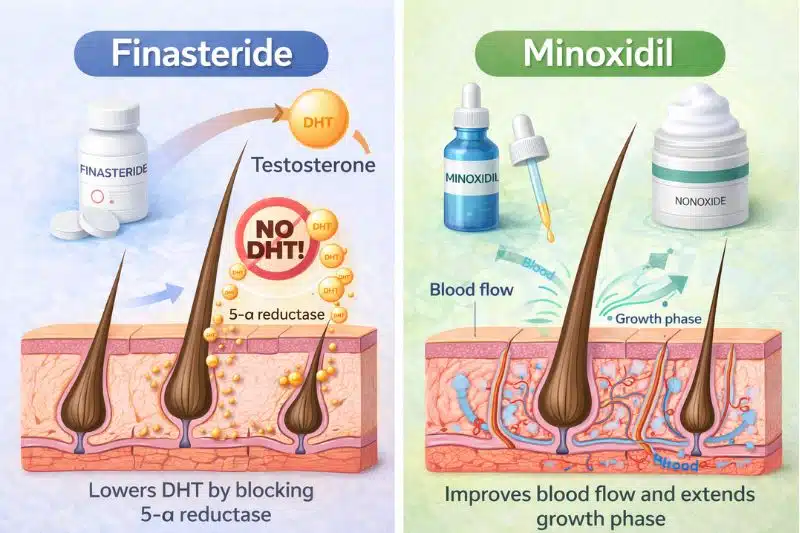
Finasteride is an oral medication that lowers DHT levels. It does this by inhibiting 5-alpha reductase, which reduces the hormone signal that drives male pattern hair loss.
Interestingly, minoxidil started as a blood pressure medication. Today, it is widely used in dermatology as a topical solution, foam, and off-label oral option. Topical minoxidil does not reduce DHT, but it affects the follicle environment, growth cycling, and blood vessels around hair follicles [3].
In layman’s terms, oral finasteride is usually the more targeted choice for male pattern baldness, whereas minoxidil topical has broader use across men and women. One study compared oral finasteride with topical minoxidil in men. The researchers found higher clinical cure rates with finasteride. However, both treatments were effective and safe in that trial [7].
A newer meta-analysis also concluded that among FDA-approved options, topical minoxidil 5% was the most effective topical monotherapy. Additionally, finasteride 1 mg/day was the most effective oral option [8].
| Treatment | Mechanism | Who uses it | Pros | Cons |
| Finasteride | Lowers DHT by blocking 5-alpha reductase. | Men with androgenetic alopecia. | Targets the hormone pathway that drives male pattern baldness. | Prescription only. It’s not indicated for women in FDA labeling. |
| Minoxidil topical | Supports follicles and stimulates hair growth. | Men and women. | Nonprescription topical option. It’s useful for broad pattern hair loss. | Requires scalp application and long-term consistency. |
| Oral minoxidil | Systemic minoxidil exposure may support a stronger growth response. | Some patients are under medical supervision. | Helpful when topical use fails. | Off-label for hair loss and more systemic side effects. |
Oral Finasteride, Minoxidil Topical, and Oral Minoxidil
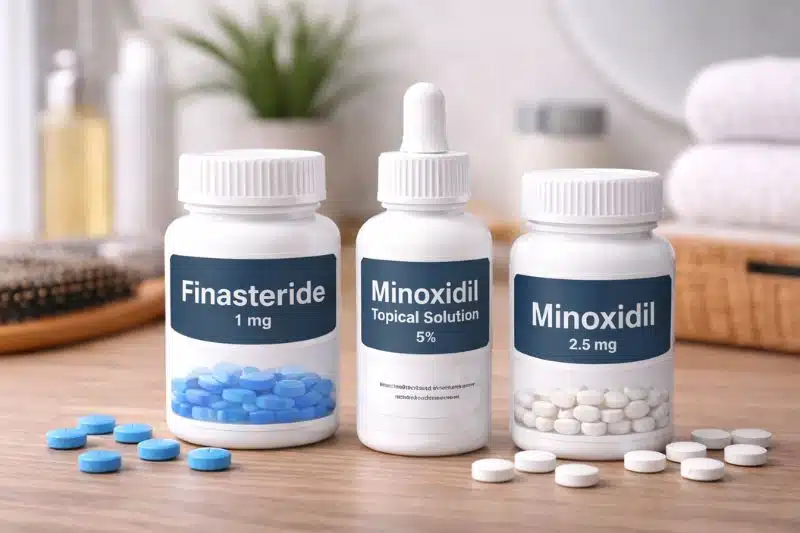
Oral finasteride is FDA-approved for male pattern hair loss in men only. The recommended dose is 1 mg once daily. Scientists from the FDA say that three months or more may be needed before you see any benefits. This prescription can combat ongoing DHT-mediated damage at the follicle level, which is why oral finasteride remains one of the most effective hair loss treatments for men with androgenetic alopecia [4].
Topical minoxidil is approved for androgenetic alopecia and should be applied to the scalp. In the DailyMed consumer label for women, 1 mL twice a day is the standard topical solution dose. Temporary shedding can happen early, and the most common side effects include:
- Scalp irritation.
- Itchy skin.
- Dryness.
- Scaling.
- Redness at the application site.
Many patients need at least four months to notice a change, so the results are quite slow. For instance, some women need six to twelve months before they know how much new growth they will get [2].
Interestingly, the use of oral minoxidil has grown exponentially, but it is still off-label for hair loss. JAMA Dermatology described low-dose oral minoxidil as an increasingly popular option in dermatology, especially for patients who do not tolerate minoxidil topical well or who struggle with adherence [5]. Of course, this does not make oral minoxidil casual or risk-free. Since it is oral and systemic, you need to pay attention to its side effects, which include swelling, fast heartbeat, dizziness, and other systemic side effects [2].
In the FDA label, year-one adverse effects above placebo included decreased libido, erectile dysfunction, and ejaculation disorder. Postmarketing reports also list depression and persistent sexual dysfunction after discontinuation. These events are not as common as we think (they’re rare), but they still matter.
Finasteride and Minoxidil: Why Combination Therapy Can Improve Hair Regrowth
The reason finasteride and minoxidil are so commonly paired is simple: the combination can affect two major drivers of hair loss at once.
- Finasteride reduces DHT exposure.
- Minoxidil supports follicle activity and stimulates hair growth through a non-hormonal path.
A 2025 systematic review and meta-analysis of seven randomized trials with 396 men found that the combination of topical finasteride and minoxidil demonstrated more efficacy versus minoxidil alone. The results were assessed when it came to hair density, hair diameter, and global photographic assessment. The authors concluded that finasteride and minoxidil together should be adopted. However, they stated that long-term trials are needed [6].
| Evidence point | What it showed | Why it matters |
| FDA finasteride label | 1 mg oral finasteride is indicated for men. The benefits may take 3 months or more. | Good fit for DHT-driven male pattern baldness. |
| DailyMed minoxidil label | 2% minoxidil topical needs continued use. Moderate regrowth in 19% of women after 8 months vs 7% with placebo. | Good fit for women and for patients who want a non-hormonal route. |
| Head-to-head study | Oral finasteride showed 80% clinical cure vs 52% for 5% topical minoxidil in one male study. | Finasteride may be more effective in some men. |
| Combination meta-analysis | Finasteride and minoxidil beat minoxidil alone on density, diameter, and photos. | Combination therapy can improve the results. |
| Oral minoxidil consensus | Low-dose oral minoxidil is useful but off-label and needs medical supervision. | Strong option when topical use fails. |
Minoxidil and Finasteride for Male Pattern and Female Pattern Hair Loss
For men with androgenetic alopecia, finasteride and minoxidil together are a rational first-line combination when the goal is to slow loss and improve regrowth. Finasteride vs minoxidil should not be viewed as a fight with one winner for every patient. The real question is whether the patient needs hormone control, follicle stimulation, or both. In male pattern disease, both are frequently the answer [4].
For women, topical minoxidil is the most established medication choice. Oral minoxidil may be prescribed for some patients. Finasteride is a prescription drug that is not indicated for women according to the FDA.
Also, the use of prescription antiandrogens in women requires stricter counseling because pregnancy exposure is a major concern. This is why women with female pattern hair loss should not self-prescribe based on a search result alone. A dermatologist should rule out other causes, such as thyroid disease, low iron levels, and nutritional deficiency, which can affect the scalp and mimic alopecia [2].
Patients also need realistic expectations. These treatments do not restore every lost follicle, and they do not reverse all baldness [6].
Conclusion
Finasteride or minoxidil is not a simple either-or choice. Finasteride is usually the more targeted oral medication for male pattern baldness because it lowers DHT, which is the hormone responsible for follicle miniaturization.
Minoxidil is the more flexible option across men and women because it is available as topical minoxidil and oral minoxidil.
For many patients, finasteride and minoxidil remain the most practical evidence-based combination because they affect different parts of the hair loss process and can improve regrowth more than monotherapy.
Book your free consultation to find out which combination of treatments will deliver the best results for your hair loss.
Frequently Asked Questions (FAQs)
1. Finasteride or minoxidil for male pattern baldness?
Finasteride is usually stronger when DHT is the main driver. However, minoxidil is a useful add-on or starting point for men who want a topical route.
2. Can women use finasteride and minoxidil?
Women commonly use topical minoxidil. Some may use oral minoxidil under medical supervision. Finasteride needs much more caution and is not a routine self-start option.
3. Does combination therapy work better than one medication?
Yes, this works for many men with androgenetic alopecia. Combination therapy can address both hormone-related follicle miniaturization and growth support at the same time.
4. How long before hair regrowth starts?
Most treatments need months so that early shedding can happen. With that said, visible change usually requires patience and consistent use.
References
1. U.S. Food and Drug Administration. (2012). PROPECIA® (finasteride) tablets prescribing information.
2. DailyMed. (2025). Hair regrowth treatment: Minoxidil topical solution USP 2% consumer information.