
Does Insurance Cover Hair Transplant Surgery? What to Know
Many patients wonder whether insurance covers hair transplant surgery because the procedure can carry substantial out-of-pocket costs. In most cases, health insurance plans classify hair transplant surgery as a cosmetic procedure and do not provide coverage. However, there are limited medical circumstances where partial or full coverage may be possible.
This article explains when insurance may cover a hair transplant and when it is unlikely to do so. It also outlines practical ways to plan for hair transplant costs if a claim is denied.
Quick Answer
- Insurance usually does not cover hair transplant surgery for male pattern baldness or a receding hairline because insurers classify it as a cosmetic procedure and not a medical necessity [1].
- Hair restoration surgery may be covered by insurance for reconstructive purposes, such as hair loss due to trauma, burns, surgical scars, and certain medical conditions [2].
Hair Loss, Cosmetic Procedures, and Insurance Coverage

In most cases, insurance coverage is denied because a hair transplant for common hair loss is treated as a cosmetic procedure rather than a medically justified surgical procedure. This “rule” applies mostly to the following conditions:
- Male pattern baldness.
- Age-related hair thinning.
- A receding hairline.
This is very important to understand, since health insurance plans often draw a distinction between cosmetic and reconstructive surgery. The American Society of Plastic Surgeons notes that hair replacement surgery may be covered when hair loss follows burns or trauma. The consequence of this rule is that some people have to deal with a severe emotional burden, but still don’t benefit from hair transplant surgery.
In fact, your health insurance provider may deny insurance claims even when a qualified hair transplant surgeon believes the procedure will produce natural-looking results. From the payer’s perspective, the question is not whether the transplant works. The question is whether the procedure meets medical necessity criteria under the policy [3].
Let’s summarize the possible insurance coverage based on different scenarios:
| Scenario | Insurance coverage | Why |
| Male pattern baldness or a receding hairline | Rarely covered. | Usually classified as purely cosmetic. |
| Hair loss after burns or trauma | Possible. | May be eligible for the reconstructive surgery classification. |
| Hair loss with surgical scars | Possible | Scar repair may fit into the medical necessity category. |
| Chemotherapy-triggered hair loss | Case by case | Depends on permanence, severity, and medical documentation (quite important). |
| Gender surgery | Varies by plan | Some policies exclude hair transplantation. |
When Reconstructive Surgery May Be Covered by Insurance
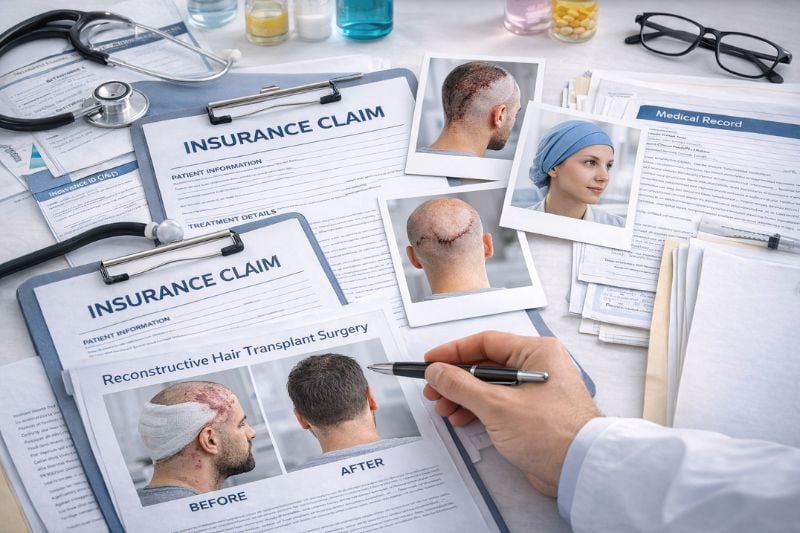
A hair transplant may be covered by insurance when it is part of reconstructive surgery after trauma, burns, or medical conditions that damage normal scalp tissue.
The American Society of Plastic Surgeons explicitly says that hair replacement surgery can be considered reconstructive treatment when hair loss results from burns or trauma. Unfortunately, this doesn’t guarantee payment, but you have a good chance that your insurer will cover your hair restoration if they are convinced the purpose is to repair rather than improve cosmetics [2].
Medical Circumstances That Strengthen a Claim
The strongest claims usually involve the following items:
- Clear medical records.
- Medical documentation.
- Extensive documentation from your doctor.
A patient who wants to cover hair restoration after an accident, surgery, or a scar-producing injury needs records that show the diagnosis, how conservative care failed, the extent of disfigurement, and why hair restoration surgery is medically justified. In certain medical circumstances, partial coverage or even full coverage could be achieved.
There is a category of hair loss that’s triggered by chemotherapy. According to research, chemotherapy-induced alopecia affects up 65% of patients. The key idea is that this type of alopecia is usually transient. With that said, there are a few documented cases in the literature of persistent or permanent hair loss after cancer treatment, especially with taxane-based chemotherapy protocols. In these cases, the argument that hair loss surgery is for reconstructive purposes tends to be stronger [5][6].
Gender Affirming Surgery and Insurance Coverage
Many policies still classify a hair transplant as a cosmetic procedure unless the insurer accepts that the hair loss is permanent, severe, and functionally/psychologically significant within the policy language. Patients in this category usually need a dermatologist, oncologist, and a hair transplant surgeon to submit medical documentation, treatment history, and a detailed explanation of why other hair loss treatments are unlikely to restore adequate hair growth.
Gender affirming surgery creates another vague area in the health insurance world. The request for scalp hair transplant in transgender patients is clearly present in clinical practice. In fact, the 2025 ISHRS census found that 81.9% of member surgeons who treated transgender patients reported scalp hair transplant as the treatment most sought by those patients. Despite this figure, coverage still varies widely across health systems and insurance plans [7][8].
Follicular Unit Extraction, Clinic Location, and Financing Options

Even when your insurance does not cover a hair transplant, patients still have several choices about technique, budget, and timing.
The final hair transplant cost usually depends on:
- The number of necessary grafts.
- The quality of donor hair.
- The clinic’s location.
- The surgeon’s medical expertise.
- Whether the plan uses follicular unit extraction or strip harvesting.
Get a free consultation and learn which method fits your case better by clicking on this link.
Technique, Graft Count, and Surgical Planning
Follicular unit extraction removes individual hair follicles one by one. On the other hand, FUT removes a strip of scalp and can leave a linear scar. ISHRS census data show that FUE remains the most commonly used method around the world. According to the report, the average number of grafts for FUE is around 2,262 per procedure, whereas FUT requires around 2,100 grafts.
Those figures answer the question of how many grafts a patient may need. At the same time, they explain why hair transplant cost can rapidly become a real burden as baldness becomes more extensive [4].
You should also keep in mind that hair transplant procedures redistribute donor hair; they do not create new hair. A skilled hair transplant surgeon must:
- Protect the donor area.
- Design a realistic hairline.
- Decide whether transplanted hair can achieve dense and natural-looking results without exhausting the available supply.
Clinic Location and Financing Options
One thing that many patients overlook is the clinic’s location. This parameter significantly changes the price. For example, a search for a Nashville hair doctor, a New York clinic, or a Florida hair clinic may show very different quotes because labor costs, facility overhead, and local demand vary by region.
The same applies when patients compare domestic surgery with overseas cosmetic surgery. This is a common trick that people fall into. You see, the upfront quote may look lower for overseas clinics. However, travel costs, aftercare, revision risk, and fragmented medical records can raise total out-of-pocket costs later.
When insurance coverage is unavailable, financing options should be considered as part of the decision. Many patients use health savings accounts, flexible spending accounts, and alternative financing options to spread the hair transplant cost over time.
Conclusion
Does insurance cover a hair transplant? Usually, no for routine male pattern baldness. However, it’s still possible when a case fits reconstructive procedures after trauma, burns, surgical scars, and other documented medical conditions.
If your hair loss followed cancer treatment, injury, or another unusual medical circumstance, ask a qualified clinic for a written assessment and submit that material to your insurance provider before you commit to surgery.
Frequently Asked Questions (FAQs) – When Do Plans Cover Hair Transplants?
Does insurance cover hair transplant surgery?
In most cases, no. Health insurance providers usually classify hair transplant surgery for common conditions such as male pattern baldness or a receding hairline as a cosmetic procedure rather than a medical necessity.
Coverage may be possible only in certain reconstructive situations, such as hair loss caused by burns, trauma, surgical scars, or other documented medical conditions.
Does insurance cover hair transplants for male pattern baldness?
Most likely, no. The majority of health insurance plans classify hair transplant surgery for male pattern baldness as purely cosmetic. Therefore, the patient usually pays the hair transplant cost without insurance coverage unless a separate reconstructive reason is presented to the insurer.
Can insurance cover a hair transplant that’s caused by burns, trauma, and scars?
Yes. Hair transplant covered under reconstructive surgery is more likely when burns, trauma, surgical scars, or a linear scar have clearly caused visible hair loss. Of course, the claim must be unequivocally documented.
Is chemotherapy-related hair loss ever covered by health insurance?
It’s decided on a case-by-case basis. If cancer treatment caused permanent hair loss and other hair loss treatments are not likely to help, some patients may have a stronger argument to cover hair restoration.
References
[1] Aetna. (2025). Cosmetic surgery and procedures (Clinical Policy Bulletin No. 0031). https://www.aetna.com/cpb/medical/data/1_99/0031.html
[2] American Society of Plastic Surgeons. (n.d.). What is hair replacement surgery?https://www.plasticsurgery.org/cosmetic-procedures/hair-transplant
[3] American Academy of Dermatology Association. (n.d.). A hair transplant can give you permanent, natural-looking results. https://www.aad.org/public/diseases/hair-loss/treatment/transplant
[4] International Society of Hair Restoration Surgery. (2025). 2025 practice census results. https://ishrs.org/wp-content/uploads/2025/05/report-2025-ishrs-practice-census_05-12-25-final.pdf
[5] Wikramanayake, T. C., Villasante Fricke, A. C., Rodriguez-Menocal, L., Smelkinson, M., Labrador, J., Shah, B., & Goldberg, L. J. (2023). Prevention and treatment of chemotherapy-induced alopecia. Cancers, 15(9). https://www.ncbi.nlm.nih.gov/pmc/articles/PMC10137043/
[6] Bhoyrul, B., Martinez-Cabriales, S. A., Zhao, J., & Jimenez, J. J. (2021). Persistent chemotherapy-induced alopecia in breast cancer survivors. JAMA Dermatology. https://jamanetwork.com/journals/jamadermatology/fullarticle/2784689
[7] UnitedHealthcare. (2019). Gender dysphoria treatment. https://www.uhcprovider.com/content/dam/provider/docs/public/policies/index/commercial/gender-dysphoria-treatment-09012019.pdf
[8] Premera Blue Cross. (2026). Gender transition/affirmation surgery and related services. https://www.premera.com/medicalpolicies/7.01.557.pdf