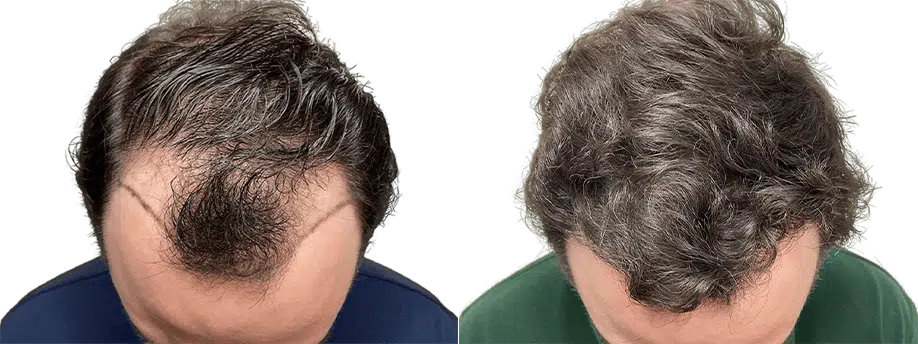
Is Hair Transplant Permanent – Long-Term Evidence
A hair transplant might feel like a permanent solution after years of hair thinning. However, the reality is a bit more complicated than this. You see, transplanted hair follicles can last for many years, but the way your hair looks might still change as the usual hair loss continues.
This article will explain what a permanent hair transplant surgery means in the field of alopecia. We will also go through the research that breaks down long-term results and ways to prolong these results.
Let’s briefly cover the basics of transplanted and healthy hair follicles:
- Transplanted follicles from a stable donor zone usually keep their genetic resistance to pattern hair loss, which supports long-term growth [1].
- Early shedding is expected. The good news is that visible regrowth tends to start after a few months (expect mature results in 6-12 months) [2].
A transplant doesn’t stop ongoing androgenetic alopecia in non-transplanted hair. Some practitioners may recommend a combination of surgery and medicines to give the best long-term results [6].
What Permanent Really Means in Hair Transplant Surgery
In surgical hair restoration, the term permanent does not necessarily mean “no change for life.” Think of it this way: the transplanted follicles will most likely behave as they did in the donor area. For this exact reason, your surgeon will choose to harvest hair follicles from regions that resist androgen-driven miniaturization [1].
The best way to understand this concept is by breaking down permanence into two layers:
1. Follicle permanence: whether the transplanted follicle survives and produces hair for years.
2. Cosmetic permanence: whether the final appearance stays dense and natural as the rest of the scalp ages.
Hair Growth Timeline After a Hair Transplant Surgery
It is very normal to experience shedding and delayed regrowth. According to the American Academy of Dermatology, transplanted hair commonly falls out between about 2 and 8 weeks. This is followed by a regrowth phase over the next few months. For the final results, most people report significant growth at 6 to 9 months. However, you shouldn’t worry if it takes more than that, as some patients come closer to 12 months [2].
The following table details the timeline of hair transplant recovery and growth:
| Time after procedure | What patients commonly notice | Why it happens |
| Days 1–7 | Redness, swelling, crusting, and soreness. | Early wound healing at donor and recipient sites [3]. |
| Weeks 2–8 | Shedding of transplanted shafts. | Follicles enter a temporary resting phase. Roots stay in place in most cases [2]. |
| Months 3–4 | Early new hairs. Fine texture. | New anagen growth begins, and thickness rises over time [2]. |
| Months 6–9 | More coverage and styling control. | More follicles shift into sustained growth [2]. |
| Months 10–12 | Mature results. | Hair coverage continues to improve [2]. |
To learn more about optimizing the survival of new grafts and improving the aesthetic of your hair, see our hair transplant recovery guide
Why Transplanted Hair Can Last: Donor Dominance and the Safe Donor Area
The idea that supports long-term results is donor dominance. This stems from the classic work of Orentreich, who described that the hair that’s moved from a resistant donor region tends to retain donor characteristics after transfer [1]. This simply means that if the hair from the donor area is resistant to different forms of alopecia, then it will retain these characteristics in the recipient’s scalp.
With that said, longer-term follow-up research demonstrates that density in a transplanted area can change over the years, which is why donor assessment and long-term planning matter [4].
What Research Shows About Long-Term Results
Current studies and clinical trials give us some solid signs about the durability of newly transplanted hair follicles, albeit long-term controlled trials are limited.
A clinical review on follicular graft survival describes how graft hydration, temperature, time out of body, handling, and recipient-site technique can influence survival and growth [5]. In practical terms, whether a hair transplant is permanent or not will depend on the physiology of the donor site and the quality of the transplantation procedure.
In a retrospective study, scientists followed 112 men after follicular unit extraction (FUT) and compared density at 1 year versus 4 years [4]. At 4 years, they found that only a small subset of these patients kept the same density. In fact, most of them showed some reduction in transplanted-area density. There is no need to panic now, since this doesn’t mean at all that transplants fail. It only shows that long-term density can change.
To give you a more in-depth tracking of the 112 men in this study, let’s go over some numbers:
| 4-year density in the transplanted area | Percentage of subjects |
| No change in density | 8.92% |
| Slight reduction | 27.67% |
| Moderate reduction | 55.35% |
| Greatly reduced | 8.03% |
Since most hair transplant cases are actually a mix of transplanted hair and native hair, the best way to reduce dissatisfactory outcomes is by protecting your native hair. In a 10-year follow-up study of 118 men on finasteride 1 mg/day, the authors found that finasteride in hair transplant case with a history of androgenetic alopecia was very effective at sustaining results. What’s more, only 6% of these participants complained of side effects [6].
FUE vs FUT: Does the Method Change Permanence?
FUE and FUT both move follicles from a donor zone to a recipient zone. Keep in mind that the biology of donor dominance applies to each.
The practical difference comes from how grafts are harvested and how the donor area heals. FUT removes a thin strip and leaves a linear scar, whereas FUE removes individual units and leaves many tiny dot scars [3].
From a longevity standpoint, the variables stay the same:
- Donor stability.
- Gentle handling.
- Recipient-site technique.
Choose the method that fits scalp laxity, hairstyle preferences, future session planning, and surgeon experience. Don’t pay too much attention to the idea that one of them guarantees permanent hair transplant results.
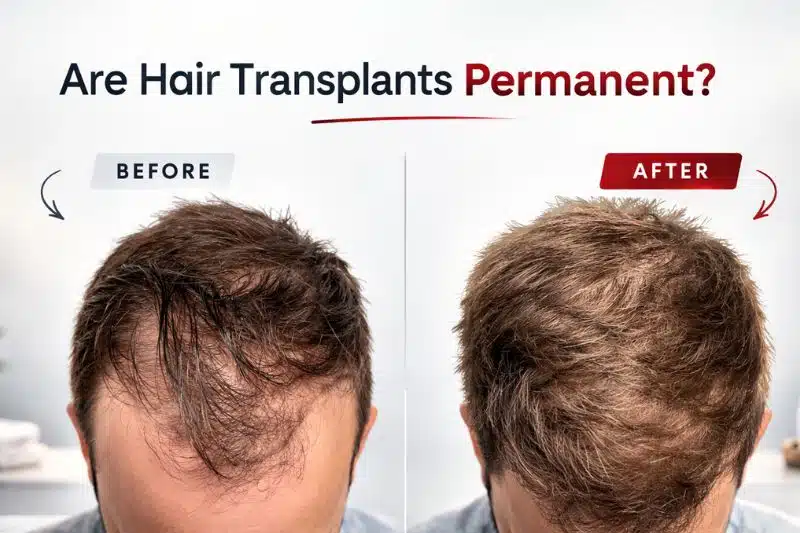
Reasons Hair Transplant Results Can Look Less Permanent Over Time
A transplant can remain technically successful, but the appearance can still change. The causes below explain most long-term changes:
Ongoing androgenetic alopecia in non-transplanted hair
The most common reason for “loss after transplant” is the continued thinning of the nearby native hair. Surgery adds hair where grafts are placed. What surgery doesn’t do is stop the underlying hormonal and genetic process elsewhere [6].
Donor miniaturization or diffuse pattern hair loss
Some patients have diffuse patterns or donor miniaturization, which reduces the reliability of safe donor hair. This is why it’s indispensable to perform preoperative assessment and choose candidates carefully [3][5].
Recipient-site limits, scarring alopecia, and donor hair
Hair transplantation in scarring (cicatricial) alopecia needs special caution. One review on transplantation in scarring alopecia found that disease control and careful selection are very important because these conditions can cause permanent follicle destruction and unpredictable outcomes [8].
Procedure variables that affect follicle survival
Even in ideal candidates, survival of the newly transplanted follicles can be compromised if the grafts dry out, warm up, stay out of the body too long, or face excessive trauma during extraction and placement [5].
Shock loss: temporary shedding of existing hair
Shock loss is temporary hair loss in the recipient area after surgery, especially where fragile native hairs exist. In a retrospective study of 621 patients who had FUE, shock loss occurred in a minority of cases [7]. This is usually temporary, but it’s something to keep in mind.

How to Make Hair Transplant Surgery Results Last Longer
Longevity improves when the plan matches your pattern of loss and your future risk. According to evidence-based research, long-term hair transplants last because of:
- Conservative hairline design that anticipates future thinning and aging.
- Donor assessment that avoids harvest outside stable hair loss zones.
- Postoperative care that protects grafts during the early phase (washing and activity must follow the surgeon’s guidance).
- A medical plan for androgenetic alopecia to protect native hair.
Who Should Be Cautious About Permanent Claims
You may sometimes have to be careful if any of these situations apply to you:
- Very young with an aggressive family history and rapid progression.
- Donor miniaturization or diffuse thinning that includes the donor zone.
- Scarring alopecia without confirmed disease stability.
- Expectations for “teenage density.”
Conclusion
A hair transplant surgery can deliver long-lasting results because transplanted follicles are likely to stay stable even if the recipient has alopecia. However, the appearance may change as natural hair loss continues.
Please don’t hesitate to request a free consultation to assess suitability and come up with a strategy that supports durable and natural-looking results.
FAQ: Is Hair Transplant Permanent
1. Is transplanted hair permanent for life
Transplanted hair can be long-lasting when it comes from a stable donor zone. This is because the new grafts will retain donor-area resistance to androgenetic loss. With that said, the nearby thinning of hair follicles affected by androgenetic alopecia may change your overall look with time.
2. Why does transplanted hair fall out after a few weeks
Early shedding is expected and usually occurs within weeks because follicles enter a resting phase after relocation. Expect new growth to appear over the next few months.
3. Do I still need finasteride or minoxidil after hair restoration
Many patients still benefit from medical treatment to prevent the shedding of native hair, which can continue even after the surgery. Talk to your healthcare provider for a personalized treatment plan.
4. Who is a good candidate for a hair transplant surgery
A second session can help if hair loss progresses or coverage needs extend beyond the original plan. These future procedures are generally only seen in a small fraction of people.
References
[1] Orentreich, N. (1959). Autografts in alopecias and other selected dermatological conditions. Annals of the New York Academy of Sciences, 83(3), 463–479.https://doi.org/10.1111/j.1749-6632.1960.tb40920.x
[2] American Academy of Dermatology Association. (n.d.). Hair transplant. Retrieved February 23, 2026, fromhttps://www.aad.org/public/diseases/hair-loss/treatment/transplant
[3] Cleveland Clinic. (2021, April 30). Hair transplant. Retrieved February 23, 2026, fromhttps://my.clevelandclinic.org/health/treatments/21519-hair-transplant
[4] Kumaresan, M., & Subburathinam, D. M. (2020). Longevity of hair follicles after follicular unit transplant surgery. Journal of Cutaneous and Aesthetic Surgery, 13(4), 292–297.https://doi.org/10.4103/JCAS.JCAS_44_20
[5] Parsley, W. M., Pérez-Meza, D., & Rose, P. T. (2010). Review of factors affecting the growth and survival of follicular grafts. Journal of Cutaneous and Aesthetic Surgery, 3(2), 69–75.https://doi.org/10.4103/0974-2077.69014
[6] Rossi, A., Cantisani, C., Scarnò, M., Trucchia, A., Fortuna, M. C., & Calvieri, S. (2011). Finasteride, 1 mg daily administration on male androgenetic alopecia in different age groups: 10-year follow-up. Dermatologic Therapy, 24, 455–461.https://doi.org/10.1111/j.1529-8019.2011.01441.x
[7] Okochi, H., Onda, M., Momosawa, A., & Okochi, M. (2024). An analysis of risk factors of recipient site temporary effluvium after follicular unit excision: A single-center retrospective study. Aesthetic Plastic Surgery, 48, 1258–1263.https://doi.org/10.1007/s00266-023-03699-z
[8] Singh, S., Muthuvel, S., & others. (2021). Role of hair transplantation in scarring alopecia—To do or not to do. Indian Journal of Plastic Surgery, 54(4), 501–506.https://doi.org/10.1055/s-0041-1739246